
My Initial Home Automation Setup with IPX800v5
In 2021, I renovated my house. When you're redoing all the electrical wiring, might as well add some home automation, right? Here's my initial setup — the one I'm currently upgrading by replacing Jeedom with Home Assistant, but that'll be another article.
TL;DR
- An IPX800v5 controller as the central brain
- Extensions for relays, inputs, and dimmers
- All lights wired back to the electrical panel (yes, lots of cable)
- Solenoid valves for zone heating
- Consumption monitoring (gas, water, electricity)
- Jeedom as the control interface
- Zigbee for temperature sensors and some smart plugs
The Heart of the System: IPX800v5 and Extensions
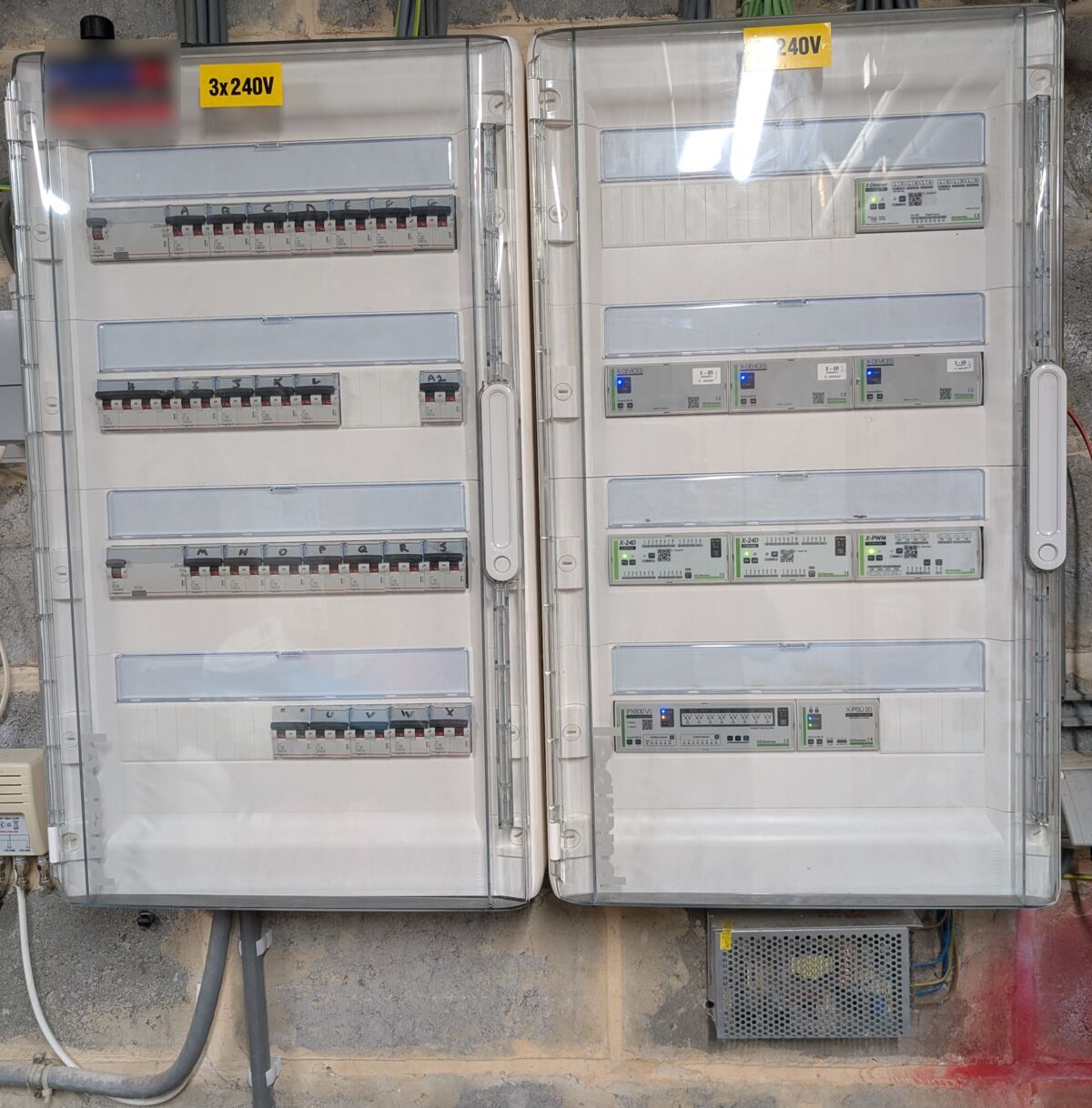
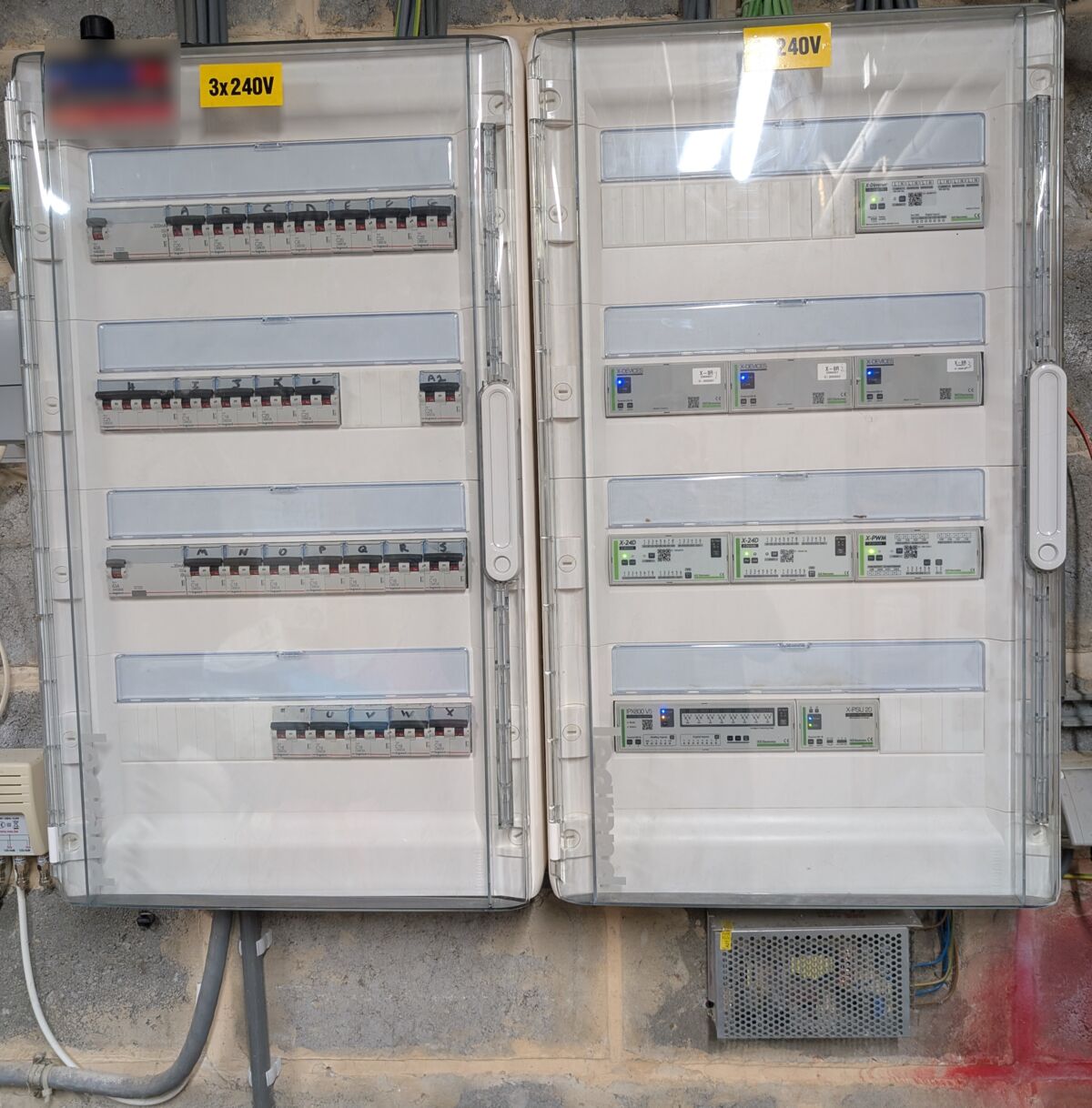
Here's my GCE Electronics equipment list:
- 1 IPX800v5 — the main controller
- 3 X8R Connect — to control my lights via relays
- 1 X24D — to receive push button inputs
- 1 XPWM — for dimmable 12V LEDs in the bathroom and shower room
- 1 XDimmer — for dimmable LEDs in the living room, dining room, and bedrooms
- 1 X-Display (old model, no longer sold) — which serves as my thermostat
The X-Display 2 unfortunately wasn't released yet at the time. My model is much more limited, but it does the job for heating control.
I chose not to connect anything directly to the IPX800v5. Everything goes through extensions. This leaves me with spare relays and digital/analog inputs for future tinkering. You never know.
Why IPX800 and Not KNX?
This question comes up often. Why not KNX, the industrial standard for wired home automation?
Honestly, I didn't want to dive into KNX configuration. It seemed too complex to me. Right or wrong, I don't know. I liked the IPX800 philosophy and its easily controllable API. Which gives infinite possibilities — that I admittedly haven't fully exploited yet.
Time will tell if I was right or wrong. For now, it's been 3 years without a single problem. We'll see my face when one of my extensions dies and I have to order a new one and rewire everything, while hearing my wife say: "See, with your crappy home automation, I told you so" :')
I must admit I don't use a tenth of the IPX800's features, since I do everything through Jeedom (and now Home Assistant). A simpler relay and digital input system would probably have sufficed, but I hadn't found anything convincing at the time.
Wiring: When Every Button Goes Back to the Panel
Such a configuration involves quite a bit of wiring. Each push button must be wired back to the electrical panel.
Here's how it's organized:
- All my lights are connected to an X8R (relay)
- The corresponding push button is connected to the corresponding relay input
This architecture allows continued use of the main lights in case of system failure (but not if the X8R itself fails). I like having a plan B.
Additionally, each push button is also connected to my X24D. This allows associating actions based on press type:
- Single click
- Double click
- Long press
It's handy for triggering different scenarios with the same switch.
Heating: Solenoid Valves Instead of Battery-Powered Valves
For my heating, I have a De Dietrich EMC-S 24/28 boiler that I used to control on/off via an IPX800 relay. Now I control it via OpenTherm, but that'll be another article.
For zone heating control, I didn't want to mess with battery-powered thermostatic valves on each radiator. I had a bad experience in my previous house: I had to change batteries every 15 days, and when I didn't do it on time, it would heat at full blast until I dealt with it. What a nightmare that was.
So I had solenoid valves installed that I control using my IPX relays. All my radiator valves are standard and always set to 5.
The models used:
- 1 1-inch solenoid valve for the ground floor circuit
- 3 1/2-inch solenoid valves for the 2 bedrooms and bathroom upstairs
The first solenoid valve controls all ground floor heating (which I couldn't divide as I would have liked — renovation constraints). The others manage the bathroom and children's bedrooms separately. This allows me to slightly heat the bedrooms at night without heating the whole house.
For temperature in each room, I use Tuya Zigbee sensors. I then created virtual thermostats that control my valves.
In my IPX, I set up 2 simple rules:
- If any valve relay is on → turn on the boiler
- If no valve relay is on → turn off the boiler
Simple but effective.
Monitoring Consumption
Gas
To monitor my gas consumption (old meter), I have an adapter that sits on the meter and sends a pulse for each dm³ consumed (if I remember correctly). This pulse is sent to a digital input on my IPX which increments a counter.
I can't find the exact model anymore, but I can look it up if anyone's interested. The thing is very accurate: I have almost no difference with the official reading after 2 years of use.
Water
Same principle, but with a light sensor that sends a pulse each time the liter needle passes. It's a bit less accurate, but still acceptable: I have a 3 m³ difference over about 400 m³ of consumption.
Electricity
Since I'm in Belgium, I had my old electric meter replaced for free with a new one. At installation, I asked to activate the P1 port. This request is free at installation but costs money afterwards — small tip if you're in the same situation.
I then connected this little Smart Gateways device. It sends all data to an MQTT server via WiFi and is powered directly by the meter's P1 port. Convenient, no outlet needed.
Zigbee Extras
In addition to the temperature sensors mentioned above, I have some Tuya Zigbee smart plugs that monitor my consumption at key locations.
This notably allows me to control the Christmas tree during the holiday season. Very important, obviously.
I also have an Alexa (yes I know, it's bad) connected to my Jeedom that allows me to control heating and lights by voice.
Jeedom as the Orchestrator
For my IPX800v5, I chose to send each light state change to an MQTT topic. I also have an MQTT topic to control each light. The config is tedious as it must be done click by click in the IPX interface, but the big advantage is that everything is instantaneous. Which is not the case with Jeedom's IPX800 plugin that polls every X seconds.
On the Jeedom side, I bought some plugins. Here's what I mainly use:
- Agenda — to control my temperature schedules
- jMQTT — for everything MQTT
- Suivi conso — to track my water, gas, electricity consumption and solar production
- Telegram — for my notifications
- thermoAlternateView — for a nice frontend for my thermostats
- thermostat — to manage my virtual thermostats
- Virtuel — to manage my virtual devices
- ZigbeeLinker — for all my Zigbee devices through MQTT (via zigbee2mqtt)
With all this, I made a dashboard per floor with my house plan and the ability to control my lights and some other things.
Assessment After 3 Years
My heating was programmed to have the right temperatures in the right rooms at the right times. Everything worked like clockwork every morning.
The system worked well for 3 years without any technical issues. But I admit I didn't use it much day-to-day. Why? Jeedom's interface wasn't great, and above all there was no decent mobile app.
That's what pushed me to migrate to Home Assistant. But that'll be for another article.
Hope this experience can help someone getting into wired home automation. If you have questions about this setup, feel free to contact me on the Fediverse!
